How Did the Titanic Sink?
Today I will tell you the story of one of the most famous ships in the world: the Titanic. The Titanic was a large passenger ship built at the beginning of the 20th century. Many people know the Titanic because of its tragic story. But only a few know exactly what happened back then. So let's travel back in time together.
The Dream of the Largest Ship
At the beginning of the 20th century, a British shipping company wanted to build the largest and safest ship in the world. This ship should be modern, able to travel very fast and offer as much luxury as a hotel.
It was named RMS Titanic. The people were thrilled. Many believed that the Titanic was unsinkable. Engineers explained that the ship was divided into many watertight areas. Even if a part were damaged, the Titanic could continue to sail. No one suspected how wrong this assumption was.
The First Journey Begins
On April 10, 1912, the Titanic started its first voyage. It set off from Southampton in England. The destination was New York in the USA. There were over 2,200 people on board: wealthy businessmen, families, emigrants and even some very well-known people.
Many passengers felt safe and happy. They wanted to start a new life in America or just enjoy a nice trip. The crew was also proud. The Titanic was a technical marvel, and everyone was convinced that the voyage would be a great success.
The Night of Misfortune
Four days later, on the night of April 14 to 15, the Titanic sailed through the North Atlantic. The sea was calm, and the sky was clear. But it was very cold, and there were many icebergs in this region.
Several ships had sent warnings in the evening. They reported large ice fields nearby. The Titanic received this news, but the ship continued to sail at high speed.
Shortly before midnight, two men in the lookout suddenly noticed a huge iceberg directly in front of the ship. They rang the alarm and shouted: "Iceberg ahead!" The officer immediately ordered the ship to turn to the left. But it was too late. The Titanic grazed the iceberg and tore several holes in the hull.
Panic on the Ship
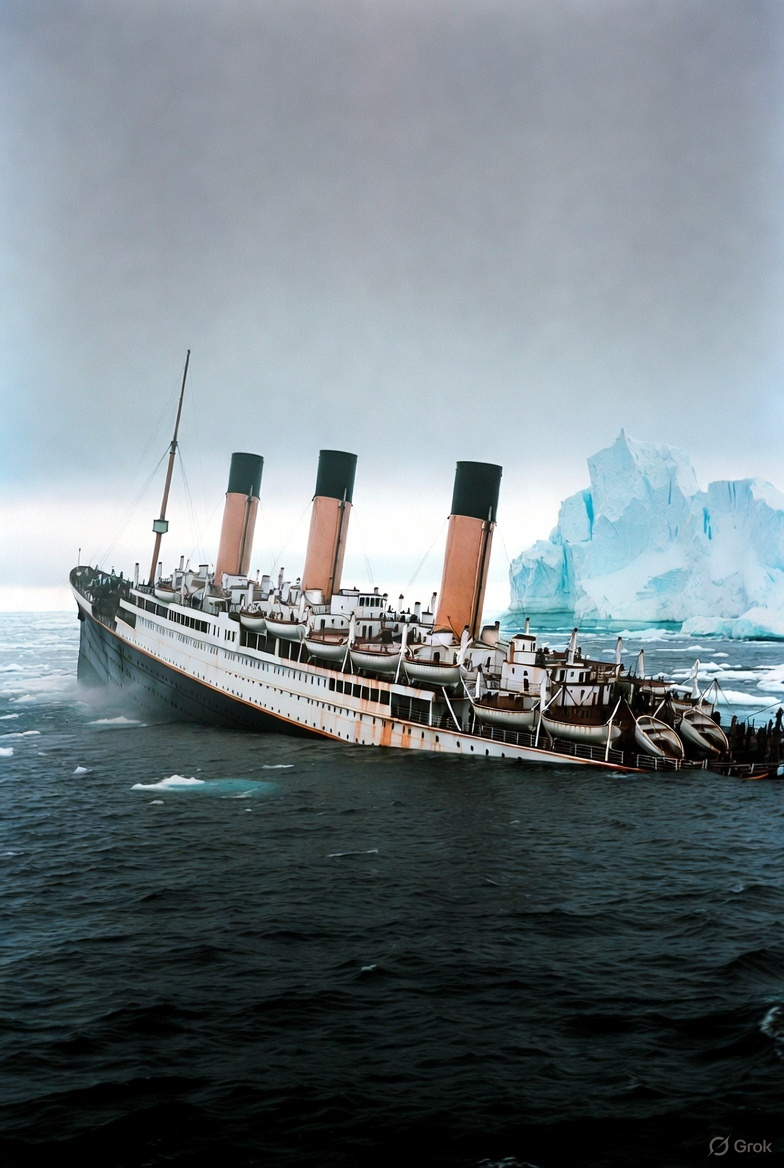
In the beginning, many people hardly noticed the collision. But the engineers quickly saw how much water entered the ship. It soon became clear: the Titanic was going to sink. The biggest problem was that there were not enough lifeboats.
There should have been many more on board, but the shipping company wanted to save space and believed that the ship could not sink.
When the crew called the people to the deck, there was chaos. Many could not believe that they had to leave the ship. Others wanted to get into a lifeboat as quickly as possible.
The rule "women and children first" was proclaimed. However, some men were also allowed to get in if there was still space.
The ship tilted more and more. The lights began to flicker. Music played for a while to calm people down. But the situation got worse and worse.
The End of the Titanic
At around 2:20 a.m., the Titanic sank completely. It disappeared into the freezing waters of the Atlantic Ocean and more than 1,500 people died – either in the water or because they had not been able to get a lifeboat.
Only about 700 people survived the disaster.
Another ship, the Carpathia, reached the survivors early in the morning. The rescued people later told their stories. Many had lost friends or family members. The world was shocked.
The End.
Vocabulary Practice
Key words from the story:
- passenger - a person traveling in a vehicle, ship, or aircraft
- voyage - a long journey involving travel by sea or in space
- unsinkable - unable to be sunk; not able to go down
- watertight - sealed against water; preventing water from entering
- icebergs - large floating masses of ice in the sea
- lookout - a person keeping watch for danger or signs of something
- grazed - touched or scraped lightly while passing
- hull - the outer covering or body of a ship
- lifeboat - a boat specially designed to rescue people at sea
- chaos - complete disorder and confusion
- sank - went down below the surface of water
- disaster - a sudden event causing great damage or loss of life
Related Learning Materials
Grammar Topics
- Past Simple Tense - The main tense used throughout this historical narrative
- Passive Voice - Sentences like "the ship was damaged"
- Conditionals - "If the ship had enough lifeboats..." type sentences
Vocabulary Practice
- Intermediate Vocabulary Page 5 - Transportation and travel vocabulary
- Intermediate Vocabulary Page 8 - Emergency and disaster terminology
- Advanced Vocabulary Page 10 - Historical and maritime vocabulary
Similar Stories
- The Unexpected Friend - Another intermediate story exploring human nature
- A Day at the Market - Practice community interaction vocabulary
- Little Red Riding Hood - Another classic story with drama and tension
Comprehension Questions
- Why was the Titanic considered unsinkable?
- Where was the Titanic traveling on its first voyage?
- What warning did other ships send to the Titanic?
- What caused the Titanic to sink?
- Why were there not enough lifeboats on the ship?
- How many people survived the disaster?
- What was the "women and children first" rule?
- What do you think could have prevented this tragedy?
Discussion Points
- Why did the ship's company ignore the ice warnings?
- What safety lessons did the world learn from the Titanic disaster?
- How have ships changed since 1912 to prevent similar disasters?
- What do you think was the biggest factor in the tragedy: the speed, the icebergs, or the lack of lifeboats?
- How would you have reacted if you were a passenger on the ship?
- Why do you think the Titanic story remains so famous over 100 years later?
Cultural Notes
The sinking of the RMS Titanic on April 15, 1912, remains one of the most famous disasters in maritime history. The ship was considered a symbol of human achievement and technological progress, which made its tragic sinking even more shocking to the world. The disaster led to major changes in maritime safety regulations, including the requirement for sufficient lifeboats for all passengers and crew, and the establishment of the International Ice Patrol to warn ships of ice dangers in the North Atlantic.